T-Mobile Home Internet is usually the better choice for people with strong 5G coverage who want lower monthly costs, while Starlink makes more sense for rural areas where regular internet options are limited.
I decided to write this after seeing more people compare these two services in YouTube comments and Reddit discussions. A few readers also asked whether Starlink is actually worth paying extra for. So I compared official plan details, real-world speed reports, and user feedback from both services.
This guide is for people trying to choose between wireless 5G home internet and satellite internet in the United States.
Table of Contents
T-Mobile Home Internet vs Starlink Overview
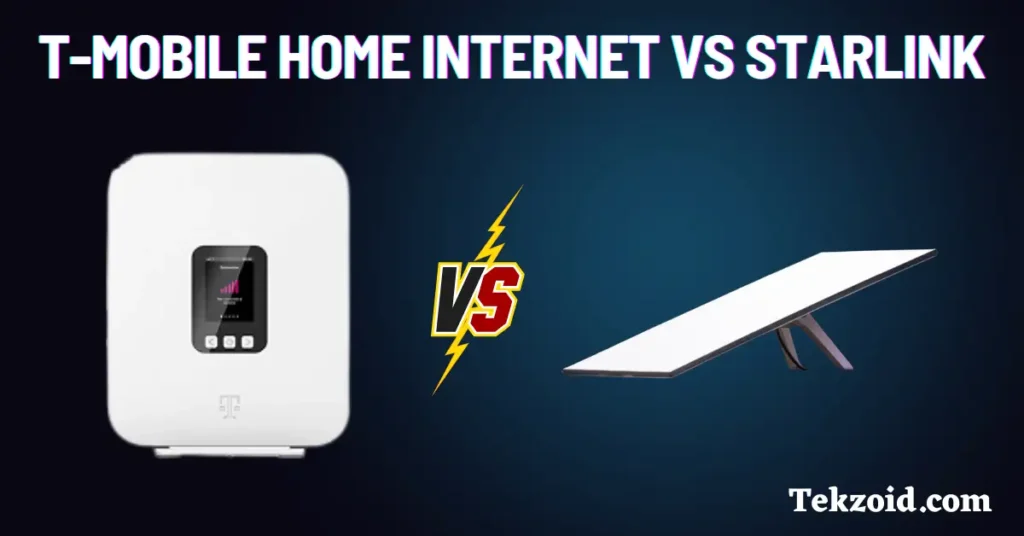
Both services aim to replace traditional cable internet, but they work very differently.
T-Mobile Home Internet
T-Mobile Home Internet uses nearby 4G and 5G cellular towers to provide wireless internet to your home.
You receive a gateway device that connects to T-Mobile’s mobile network. Setup is simple because there’s usually no technician visit or drilling required.
Starlink
Starlink uses low-Earth-orbit satellites operated by SpaceX to deliver internet service.
Instead of connecting to cell towers, your home connects to satellites through a dish installed outside with a clear view of the sky.
Main differences between the two services
- Cellular network vs satellite network
- Lower monthly cost vs wider availability
- Indoor plug-and-play setup vs outdoor dish installation
- Better urban coverage vs stronger rural coverage
Internet Technology, Cellular vs Satellite
The technology behind each service affects speed, latency, reliability, and availability.
How T-Mobile Home Internet works
T-Mobile Home Internet connects to nearby cellular towers using 5G or 4G LTE.
Main advantages
- Lower latency compared to satellite internet
- Faster setup process
- No roof installation required
- Good speeds in strong coverage areas
Main limitations
- Speeds can slow down during network congestion
- Performance depends heavily on tower distance and signal quality
- Availability is limited in some locations
If your area already has strong T-Mobile 5G coverage, performance can be surprisingly solid for streaming, browsing, and remote work.
How Starlink works
Starlink connects directly to satellites orbiting Earth.
This allows internet access in places where cable, fiber, or cellular coverage barely exists.
Main advantages
- Available in many remote and rural areas
- Works where traditional ISPs do not reach
- Better coverage flexibility for travelers and remote users
Main limitations
- Higher equipment costs
- Requires outdoor installation
- Weather and obstructions can affect performance
Trees, heavy rain, or poor dish placement can reduce signal quality.
T-Mobile Home Internet vs Starlink Speeds
Real-world speeds vary heavily based on location for both providers.
T-Mobile Home Internet speeds
Typical performance looks like this:
- Download speeds are around 100 to 300 Mbps
- Upload speeds are around 10 to 40 Mbps
- Lower latency compared to satellite internet
In some crowded areas, speeds can slow down during peak evening hours because mobile towers prioritize phone traffic differently.
Starlink speeds
Typical Starlink performance includes:
- Download speeds are around 50 to 250 Mbps
- Upload speeds are around 10 to 40 Mbps
- Latency is lower than that of older satellite internet services
Compared to traditional satellite providers, Starlink feels much faster and more responsive.
But speeds still vary depending on:
- Your region
- Satellite coverage load
- Weather conditions
- Dish placement
Pricing Comparison
Pricing is one of the biggest differences between these services.
T-Mobile Home Internet pricing
T-Mobile Home Internet usually costs around:
- $35 to $70 per month
- No major equipment fee
- Discounts for existing T-Mobile phone customers
- Price-lock offers in some plans
For most households, it’s the cheaper long-term option.
Starlink pricing
Starlink pricing is higher overall.
Typical costs include:
- Around $50 to $165+ per month, depending on plan type
- One-time equipment fee that can cost several hundred dollars
- Extra charges for portable or roaming plans
The higher upfront equipment cost is what stops many users from switching.
Data Caps and Availability
T-Mobile Home Internet
- Unlimited data included
- Only available in supported coverage areas
- Availability depends on network capacity
Even if T-Mobile coverage exists nearby, home internet service may still be unavailable if local towers are overloaded.
Starlink
- Unlimited data on most plans
- Available in many rural and remote regions
- Requires a clear sky view for the satellite dish
For people living far outside cities, Starlink often becomes one of the few realistic broadband options.
Which One Should You Choose?
Choose T-Mobile Home Internet if:
- You already have strong T-Mobile coverage
- You want lower monthly costs
- You prefer a simple setup
- You mainly stream, browse, or work from home
- You live in a suburban or urban area
Choose Starlink if:
- You live in a rural or remote area
- Cable and fiber are unavailable
- Cellular internet is unreliable
- You travel frequently with internet equipment
- You need internet in off-grid locations
Plus, you can also use an external antenna with T-Mobile Home internet.
Video:
Final Thoughts
For most city and suburban users, T-Mobile Home Internet offers better value because it’s cheaper and easier to set up.
But if you live in an area with weak cellular coverage or almost no broadband options, Starlink can completely change your internet access situation.
The better option depends less on marketing claims and more on your exact location.
FAQs
Is Starlink faster than T-Mobile Home Internet?
Not always. In strong 5G areas, T-Mobile Home Internet can actually deliver faster speeds and lower latency than Starlink.
Does the weather affect Starlink internet?
Yes. Heavy rain, snow, and obstructions like trees can affect Starlink signal quality and speeds.
Can I game on T-Mobile Home Internet or Starlink?
Yes, but performance depends on latency and network stability in your area. T-Mobile usually has lower latency, while Starlink may perform better in remote areas with limited alternatives.
